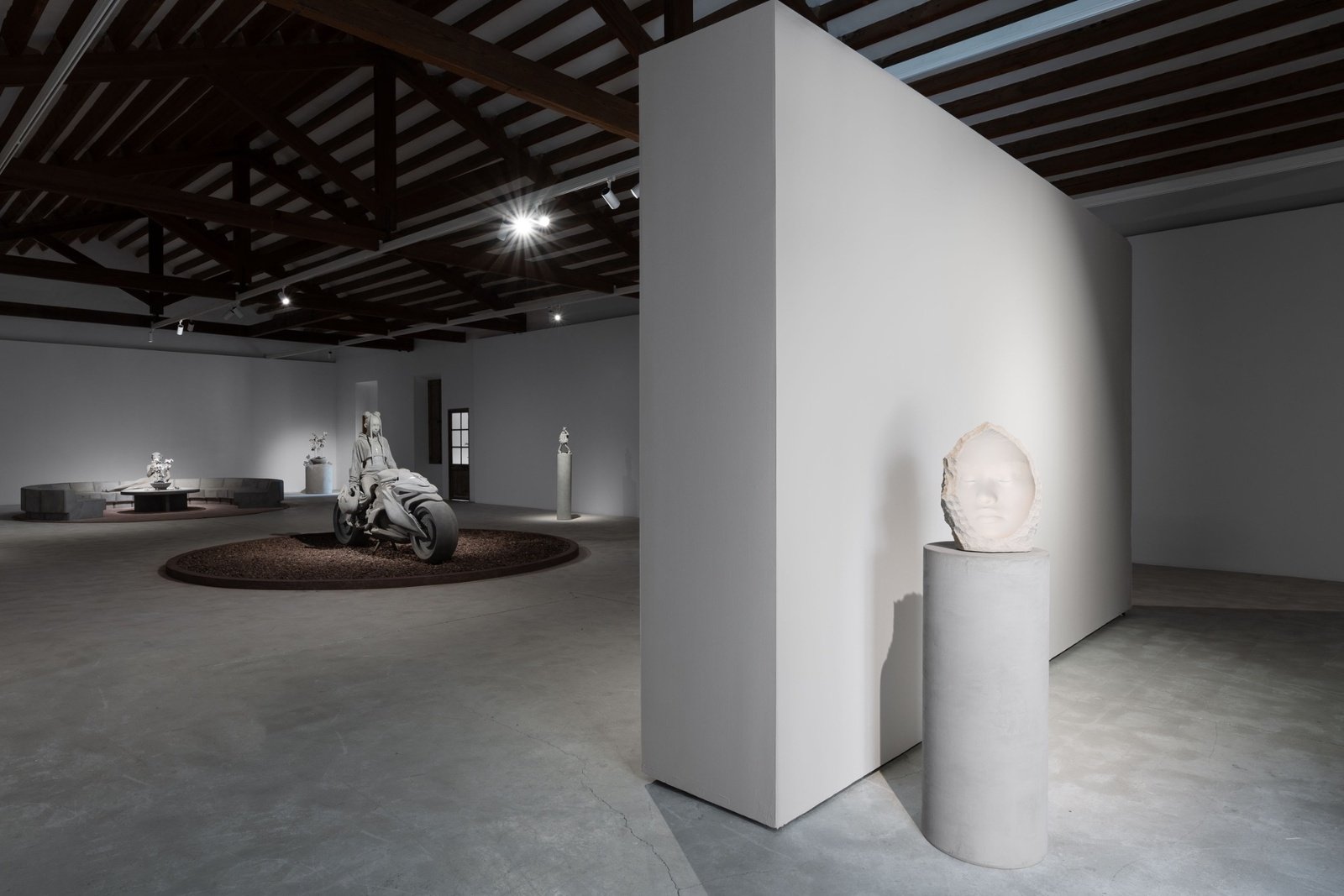
To inhabit the present is to live with an increasingly evident paradox: never before have we been so connected, and yet the feeling of distance has become ever more real. It is precisely within this tension that Alejandro Monge’s sculptures are situated. In Synthetic Future, the artist does not turn his gaze toward a hypothetical future, nor does he construct a scenario of impending collapse; instead, he approaches transformations that are already embedded within everyday experience, altering the ways we look, occupy space, and relate to one another. The synthetic appears here not as a rupture, but as a presence that permeates the body, perception, and the experience of the present. The human figure thus ceases to assert itself as a stable identity and becomes a condition in constant negotiation with its surroundings, where the future no longer belongs to what is yet to come, but to the way we inhabit the present moment.
Presented at LA BIBI Gallery in Palma de Mallorca, the exhibition unfolds as a continuation of Synthetic Nature, recently shown at the IAACC Pablo Serrano in Zaragoza. Some works reappear here transformed, reconfigured both by the change of context and by the evolution of the ideas that sustain them; others emerge for the first time, extending previous lines of inquiry and expanding them in new directions.
It is difficult not to situate Alejandro Monge’s practice within a sculptural tradition that, from Greco-Roman antiquity to the present, has used the body as a vehicle for exploring fundamental questions of existence. If classical statuary associated beauty, proportion, and harmony with an idea of order, today the body ceases to be a certainty and becomes instead a question.
Within the Spanish context, artists such as Juan Muñoz introduced a psychological and narrative dimension to sculpture, placing figures within a theatrical register. Similarly, Jaume Plensa has explored the body as a space of interiority, examining its physical and spiritual essence and its relationship with nature; while Bernardí Roig investigates the disorientation of the contemporary individual within a society saturated by mass media, where the erosion of memory, identity, and communication blurs the boundaries between truth and fiction.
Drawing upon this tradition, Alejandro Monge shifts these concerns into a territory shaped by technology, artificiality, and the transhumanist imagination. His figures retain the centrality of the body, the physical presence of sculpture, and a direct relationship with the viewer, yet they replace certainty with unease: what does it mean to remain human in a world where the boundaries between body, technology, and identity are beginning to dissolve?
It is precisely from this uncertainty that the works also acquire a generational dimension. They speak to an era defined by permanent hyperconnectivity and, at the same time, by a growing sense of emptiness, isolation, and emotional disconnection. The figures share the same space, yet seem to inhabit it in isolation, as though each remains absorbed within its own reality, detached from those of others.
This condition is crystallised in works such as The Grey Orchid, where a reclining figure, absorbed by the screen of a personal device, occupies a space traditionally associated with rest, encounter, or intimacy, yet without activating any of these possibilities. Attention is directed not toward the immediate environment but toward its mediation: on the screen appears the same still life positioned before the figure, reproduced as an image. The present becomes an image, and in that gesture experience is distanced from itself.
In contrast to this stillness, The Last Nomad introduces a motorcycle as an image of suspended mobility. The figure seated upon it neither advances nor appears to rest; instead, it remains fixed within a moment that seems endlessly prolonged. The machine, commonly associated with speed and movement, loses its usual function here and becomes an immobile object, suspended between the possibility of departure and the impossibility of leaving.
The Inverse Shapes pieces extend the exhibition into the garden, where faces carved into stone disrupt the perception of space and transform absence into presence. Dimensionality itself appears inverted and, within this strangeness, androgynous figures emerge, observing us from matter eroded by time, like archaeological vestiges of a present in the process of disappearing. Far from depicting specific individuals, Alejandro Monge employs portraiture as a reflection on the human condition and its permanence, generating forms suspended between presence and absence, between the organic and the fossilised.
Materially, the sculptures reinforce this sense of estrangement. Through the use of resin and cement, Monge constructs homogeneous surfaces that evoke a synthetic skin, where the boundaries between body and environment dissolve. The uniform grey neutralises any visual hierarchy and creates an atmosphere that is cold, silent, and suspended. Matter acquires a conceptual dimension here, functioning as a physical record of a reality in which the organic and the technological can no longer be clearly distinguished.
Standing before these works, the viewer becomes part of the experience itself. The scale of the sculptures and the immersive arrangement of the space place the spectator within these tensions. The exhibition does not merely represent a contemporary mode of existence; it reproduces it within the visitor’s own experience: an environment where proximity coexists with disconnection, and where physical presence does not necessarily guarantee encounter.
What the exhibition ultimately sustains is not simply an image of the present, but the sensation that something essential has already begun to change, even if we do not yet know how to name it. In Synthetic Future, the question is not how much the world has changed, but how our way of inhabiting it has been transformed.
María García Marqués & Ester Almeda